
Math curriculum
The best homeschool math curriculum by learner type
There is no single best math curriculum. The useful question is whether your child needs conceptual challenge, explicit teaching, repetition, manipulatives or a low-friction independent routine.
By Homeschool Best editors · Updated September 1, 2026 · 10 min read

The short answer
Beast Academy is our pick for mathematically eager learners; Math-U-See and RightStart Math are stronger hands-on choices; Teaching Textbooks and CTCMath reduce parent teaching load; Singapore Math rewards families willing to teach conceptually; and Nicole the Math Lady is useful when a family wants Saxon support rather than another curriculum.
How we chose
We compared the actual teaching job each program performs, how much parent instruction it assumes, whether pricing compounds per child, and recurring fit complaints. ESA eligibility remains separate and is shown on each linked product profile.
Our picks
1

Beast Academy
Best for advanced and puzzle-loving learners
- Best for
- Children who enjoy comics, hard problems and discovering patterns.
- Watch for
- The intentional difficulty can turn productive struggle into daily frustration for a learner who needs more routine practice.
- Price
- $100-$160/year online; books sold by level
2

Math-U-See
Best mastery-based manipulative program
- Best for
- Learners who need to see and build a concept before moving to symbols.
- Watch for
- The sequence differs from many grade-level programs and the parent still needs to teach consistently.
- Price
- $130-$200 for a level set; manipulatives extra once
3
RightStart Math
Best hands-on parent-led option
- Best for
- Young learners who respond to games, an abacus and varied mental-math activities.
- Watch for
- Materials and lesson setup demand more parent time than a self-paced app.
- Price
- $130-$190 per level; reusable manipulative kit costs extra initially
4

Teaching Textbooks
Best low-friction independent routine

- Best for
- Families prioritizing automated instruction, grading and a gentle daily cadence.
- Watch for
- Some learners need additional challenge or written work beyond the program.
- Price
- $45-$75 per course/year; family plan available
5

CTCMath
Best value for larger families
- Best for
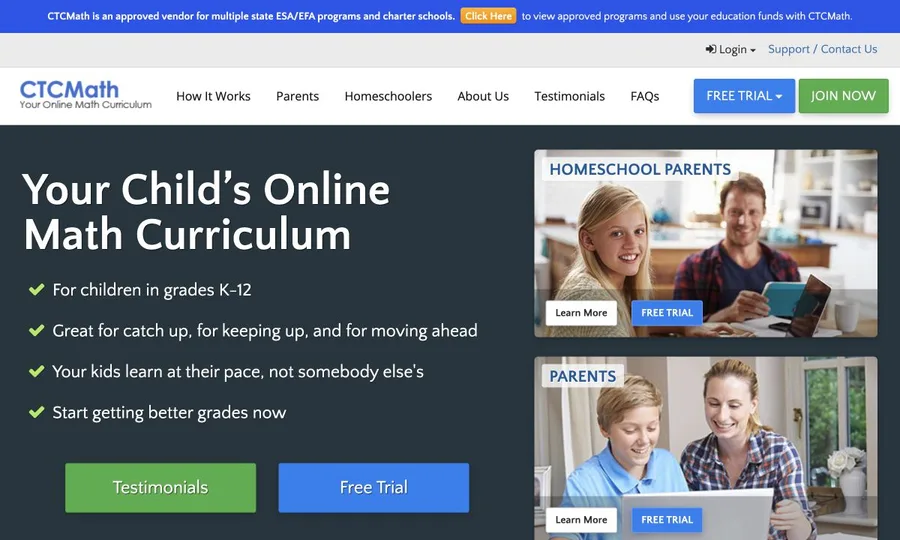
- Multi-child households wanting concise video instruction and broad grade coverage.
- Watch for
- Short explanations and interface-first learning will not suit every child.
- Price
- $120-$200/year, frequent homeschool discounts
6

Singapore Math
Best conceptual print curriculum

- Best for
- Parents comfortable teaching a coherent concrete-to-pictorial-to-abstract progression.
- Watch for
- Edition choice and placement can be confusing, and it is not hands-off.
- Price
- $80-$180 per level depending components
7

Mr. D Math
Best for live accountability
- Best for
- Middle and high school learners who benefit from a scheduled instructor and visible support.
- Watch for
- Live courses cost more and reduce scheduling flexibility.
- Price
- $200-$700 per course depending self-paced vs live
8

Nicole the Math Lady
Best Saxon teaching companion
- Best for
- Families who like Saxon’s sequence but need video teaching and automated support.
- Watch for
- It depends on separate Saxon materials and inherits the repetition that some learners dislike.
- Price
- $80-$160/year depending plan
Start with placement, not grade labels
A program’s Grade 5 is not guaranteed to match another program’s Grade 5. Use the publisher’s placement process, inspect a real lesson and check prerequisite skills before buying a year. Placement matters more than the age printed on the cover.
When a child has gaps, moving sideways into a better-fitting sequence is usually more productive than buying an advanced label and spending the year remediating inside it.
Budget parent time as well as money
A lower-priced book can be expensive in parent attention. A subscription can be good value if it reliably returns teaching time, but poor value if the child clicks through without understanding. Decide whether you are buying instruction, practice, grading or all three.
For multiple children, explicitly check whether a subscription is per learner, per family or limited to a fixed number of profiles. Consumable workbooks also recur even when instructor materials can be reused.
Do not confuse engagement with mastery
Games, animation and rewards can get a child to the lesson, but the evidence you need is whether they can explain the idea, solve an unfamiliar problem and retain it later. Pair any digital program with occasional work away from the interface.
Common questions
What is the best homeschool math curriculum for ADHD?
There is no universal ADHD pick. Short lessons, visible progress, immediate feedback and reduced copying often help, but some learners regulate better with manipulatives than screens. Trial the actual lesson format.
Should one curriculum work for every sibling?
Not necessarily. Sharing a platform can simplify administration, but math fit is individual. Reuse what works and allow different instructional formats when children need them.
Does an ESA listing cover every math package?
No. A provider listing can be state-, program-, seller- and offering-specific. Follow the evidence and purchasing route on the product and state pages.